Categories
news

AEL Wins Mistrial in Federal FARA, Fraud and Money Laundering Trial; Jury Deadlocked on All Counts

This afternoon, a federal jury in the Eastern District of New York deadlocked on all counts against AEL’s client Linda Sun and her husband and co-defendant Chris Hu. The Honorable Brian M. Cogan declared a mistrial on all counts against both defendants.

Lead trial counsel, AEL partners Ken Abell and Jarrod Schaeffer, issued the following statement immediately following the mistrial:

“Throughout this trial, Linda Sun has steadfastly maintained her innocence. The inability of dedicated jurors to reach a unanimous verdict despite nearly a week of deliberation underscores the deeply flawed and questionable nature of the novel charges in this case. Indeed, the government tried to use multiple federal criminal statutes to prosecute a dedicated public servant for doing her job for New Yorkers. She did not commit any crimes and today, she has obtained a modicum of vindication. Despite the enormous toll this has taken on her and her family, she returns home today without the weight of a criminal trial or any convictions. We sincerely hope that the government considers the jury’s inability to reach a verdict on any count against any defendant before taking this flawed case to trial again.”

The mistrial concludes a complicated, hotly contested month-long trial. AEL’s client Linda Sun was the former Deputy Chief Diversity Officer to former Governor Andrew Cuomo and the Deputy Chief of Staff to current-Governor Kathy Hochul. On August 26, 2024, she was charged in a 10-count indictment with, among other things, conspiracy to violate the Foreign Agents Registration Act (FARA), failure to register under FARA, visa fraud and alien smuggling, and money laundering conspiracy. Over the next several months, the government superseded three times adding additional charges and conflicting legal theories, including honest services wire fraud and federal program bribery. Mr. Hu, Linda’s husband, was also charged on multiple counts. In the leadup to trial, there was substantial litigation, including motions to dismiss, motions to suppress over perceived discovery lapses by the government, and the disclosure of classified exculpatory materials. 

On November 12, 2025, trial against Linda Sun and Chris Hu commenced. In his opening statement, Mr. Schaeffer rejected the government’s theories of criminal liability against Ms. Sun. “For more than a decade,” said Schaeffer, “[Linda Sun] worked for [New York State] and didn’t commit crimes by doing her job. As you will learn during this trial, Linda has committed the better part of her professional life to serving the public[.] We are here because despite her record of impressive public service, the government has charged Linda with crimes that assault everything she’s built her life around.”

Mr. Schaeffer attacked the government’s varying and sometimes-conflicting claims against Ms. Sun. Regarding the FARA counts – in which the government accused Ms. Sun of failing to register as a Chinese foreign agent – Mr. Schaeffer dismissed the charges as “nonsense”:

“Linda has lived in this country since she was a child, when her family came here to pursue the American dream. She grew up here. She went to school here. She’s raising her family here. She is an American and she is a New Yorker . . . . You won’t see evidence that Linda followed orders from China or disregarded New York’s interests because foreign officials told her to. Instead, the evidence is going to show Linda working on behalf of New Yorkers . . . . It was her job to communicate with the consulate, to cultivate relationships that benefit New Yorkers, and to help her superiors, the highest political office in the state, to avoid alienating a significant voting bloc in New York[.]”

Mr. Schaeffer also pointed out the absurdity of the government’s evidence stating, “the government’s claim that Linda became a foreign agent for some salted ducks might be funny if the consequences for her family weren’t so serious.” “Even stranger” was the government’s claims that Linda illegally brought aliens into the United States by helping a recognized Chinese delegation visit with the then-Lieutenant Governor, noting that some in the delegation already had visas and that they all went home after their visit to New York. On the fraud and money laundering counts, Mr. Schaeffer urged the jury to listen closely to the evidence and use their common sense. “You’ll see no evidence proving beyond a reasonable doubt that Linda did anything wrong in connection with PPE contracts.”

Over the course of the trial, the government put on forty-one witnesses but none offered direct evidence of any wrongdoing and the text messages and other evidence that the government said showed disloyalty and fraud failed to tie together its various theories in any coherent way. Ken Abell delivered the summation for Linda Sun:

“Foreign influence, money, China, . . . . political official for sale, the government made that sound so dramatic when this case started[.] The story, however . . . has huge holes in it. It has a lot of unanswered questions. And at the end of the day, . . . it just does not hold together the way the government says it does. And respectfully, I think the government knows that. That’s why [the government] admitted to you, there’s no witness who can tie all that together . . . . The government failed to deliver on the promises that it made to all of you at the beginning of this trial.”

Mr. Abell pointed out that the government called fourteen witnesses – over a third of their presentation – that had nothing to do with the investigation and had no direct knowledge of the evidence. Mr. Abell called them “readers” because all they did was read emails and text messages without context, comprehension, or explanation. “Now, what we’re left with . . . at the end of this long trial is a hodgepodge of accusations and pieces of evidence that simply don’t prove the charges against [Linda]. And they definitely don’t prove them beyond a reasonable doubt.”

For example, on the FARA charges, Mr. Abell pointed out that the government’s own witnesses admitted that Ms. Sun’s conduct with respect to China and Taiwan “were consistent with what had been done in the past;” in other words, “Linda did not stonewall representatives of the Taiwanese government” to benefit China. “That’s not fair, that’s not accurate, it’s not a reasonable assumption,” said Mr. Abell. Regarding other aspects of the government’s so-called evidence that Ms. Sun acted as a “foreign agent,” Mr. Abell noted, “I want to repeat it because it’s so striking. Every single New York government witness agreed that [the conduct] was part of Linda’s job.”

On the fraud and money laundering charges, Mr. Abell pointed out that the government’s case against Ms. Sun was based on innuendo rather than evidence. “The government went to great length during this trial to show you as much money and purchases as it possibly could. The theory seems to be that money and China and state government is an enticing mix. And the government’s hoping that you’re distracted by the implications of that. Because that’s all it is, implications. There was no evidence linking that money to specific crimes.” In the end:

“The government got key parts of this case wrong, just simply wrong. And they threw the kitchen sink at these folks, at Linda and Chris[.] Foreign agent charges, wire fraud, immigration counts, money laundering, you name it. A hodgepodge of evidence with holes so big you could drive a truck through some of them. But what does the evidence actually show in the end? Nothing close to what the government claimed . . . . [Linda] is not a foreign agent[.] She did not commit immigration offenses. She did not take bribes or defraud the State of New York. And she did not launder criminal proceeds that never existed. That’s the true story here.”

After eighteen days of trial, forty-nine witnesses (eight called by the defense), 758 exhibits, and six days of deliberation, the jury could not reach consensus on any of the government’s theories or evidence against any defendant.

Ms. Sun was represented at trial by Ken Abell, Jarrod Schaeffer, Nafeesah Attah and Charlotte Woods. Mr. Hu was represented at trial by Nicole Boeckmann and David Shargel of Bracewell.

Categories
news

Joshua Haber, Former Federal Prosecutor and Crim Chief, Joins AEL as Partner

AEL is proud to announce that former federal prosecutor Joshua L. Haber has joined the Firm as a Partner.

Josh joins AEL after a distinguished career in government service, both as an Assistant U.S. Attorney (AUSA) for the District of New Jersey (DNJ) and as an Assistant District Attorney (ADA) for the New York County District Attorney’s Office (DANY).

As an AUSA, Josh rose to the level of Chief of the Criminal Division, the top position in the Criminal Division, where he supervised approximately 100 federal prosecutors handling criminal cases of every variety. Prior to serving in that role, Josh also served as the Deputy Chief of the Criminal Division, the Chief of the Economic Crimes Unit, and as an AUSA in the Health Care Fraud Unit.

During his eight years as a federal prosecutor, Josh distinguished himself as an exceptional investigator and trial attorney who handled the Office’s most high-profile and complicated white-collar criminal cases. Among other notable matters, Mr. Haber supervised the prosecution of TD Bank for pervasive failures to prevent money-laundering, which resulted in $1.8 billion in criminal penalties and the first-ever guilty plea by a major bank for violating the Bank Secrecy Act. He also supervised the investigation and trial of recidivist Ponzi-schemer Eliyahu “Eli” Weinstein. And he co-led the investigation and prosecution of the largest-ever Foreign Corrupt Practices Act (FCPA) case against a pharmaceutical company. He received the prestigious “Prosecutor of the Year” award three years in a row from the Federal Law Enforcement Foundation. Before his career as a federal prosecutor, Mr. Haber was also prosecutor at DANY, where he served in the Appeals Division.    

“We are thrilled to welcome Josh to the firm as a partner,” said David Eskew, one of AEL’s three founding partners. “Josh’s incredible career, culminating in his promotion to the top position in the Criminal Division, speaks for itself. He is a phenomenal litigator and trial attorney with a track record of success in and out of the courtroom. He is also a wonderful person with great judgment who elevates the attorneys around him. Josh immediately complements our talented team and further enhances our ability to represent our clients in high-stakes criminal and civil litigation.”

“I’m thrilled to join the dynamic and expanding team at AEL,” said Mr. Haber. “I look forward to collaborating with this roster of highly talented and experienced attorneys as we help clients navigate their most complex challenges, both in and out of the courtroom.”

Josh will work on white collar criminal cases and government investigations, False Claims Act litigation, and internal investigations. He specializes in the areas of securities fraud, healthcare fraud, bank/wire fraud, public corruption and bribery.

AEL was founded in 2020, just weeks before the global pandemic, by three former federal prosecutors. Since then, the Firm has grown to thirteen lawyers, boasting six former federal prosecutors hailing from the Eastern and Southern Districts of New York and the District of New Jersey, and two former prosecutors from the New York County District Attorney’s Office. AEL specializes in white collar criminal defense and federal civil litigation, with a particular focus on high-profile fraud and corruption cases and False Claims Act (FCA) litigation in New York and New Jersey. AEL also provides transactional, regulatory and compliance advice to healthcare companies. AEL is ranked as a top Firm by multiple legal peer-rating companies for its work in the areas of white-collar criminal defense, healthcare, and commercial litigation.

This post contains attorney advertising. Prior results do not guarantee similar outcomes in future matters.

Categories
news Uncategorized

Benchmark Litigation Names Ken Abell and David Eskew “Litigation Stars”

AEL is proud to announce that Benchmark Litigation® named partners Ken Abell and David Eskew as Litigation Stars 2025 in the areas of White Collar Criminal Defense and Commercial Litigation, two of AEL’s core practice areas.

Both Ken and David frequently litigate in federal and state cases, on both the criminal and civil sides, with a string of successful outcomes and victories. Ken’s recent engagements include representing the main defendant in a federal criminal trial charging violations of the Foreign Aliens Registration Act, wire fraud and money laundering in the Eastern District of New York. David is representing a physician who operated a chain of COVID-19 testing clinics in an upcoming federal criminal trial in the Southern District of New York. And Ken and David have teamed up to defend a large hospital system in an ongoing qui tam case alleging violations of the Antikickback Statute and federal False Claims Act in the District of New Jersey.

AEL is a boutique law firm that focuses on federal civil litigation, False Claims Act litigation, white collar criminal defense, healthcare regulatory and compliance matters, highly-sensitive internal investigations, and healthcare transactions. AEL now boasts a team of six former federal prosecutors hailing from the Southern and Eastern Districts of New York and the District of New Jersey, two former state prosecutors, and a team of thirteen attorneys.

Categories
news

Best Lawyers® Names Scott Landau Lawyer of the Year for NYC Healthcare; Honors Five Other AEL Attorneys

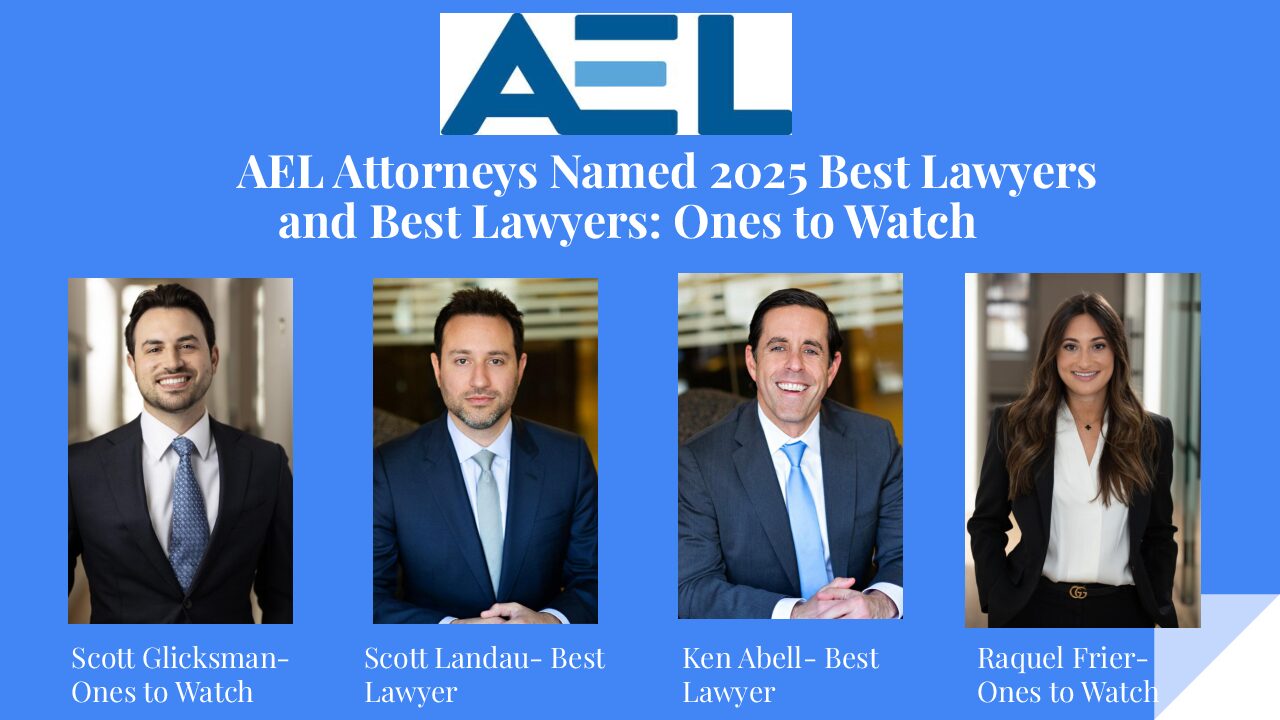
AEL is thrilled to announce that Best Lawyers® honored six AEL attorneys in its 2026 edition.

Founding partner Scott R. Landau was recognized as the 2026 “Lawyer of the Year” in Health Care Law for New York City.  This prestigious honor is awarded to just one lawyer per region and practice area each year. The honor is based on the highest overall peer feedback and a demonstrated record of excellence. AEL is incredibly proud that Scott has been recognized for his stellar reputation in the NYC healthcare community. Scott was also named a “Best Lawyer” for Health Care Law marking the third year in a row he has obtained the honor.

Founding partner Ken Abell was also named a “Best Lawyer” in the categories of Health Care Law and Health Care Litigation. Counsel Jeff Braun was named a “Best Lawyer” in the category of Litigation – Land Use and Zoning and Litigation – Real Estate. And associates Scott Glicksman and Raquel Frier, and Of Counsel Katherine Kulkarni were each named as “Ones to Watch.”

The Best Lawyers in America list is one of the most reputable and recognized rankings of attorneys across the nation. Those honored are divided by geographic region and practice area(s) and their work undergoes a significant peer review process.

Best Lawyers: Ones to Watch in America recognizes associates and other early stage attorneys, noting their impressive performance and professional excellence in private practice. Ones to Watch utilizes the same robust peer-review process and methodology as The Best Lawyers in America.

Categories
news

AEL Files Amicus Brief in Supreme Court Case Relating to Criteria for Sentencing Reductions

On August 15, 2025, Abell Eskew Landau LLP filed an amicus curiae brief in the U.S. Supreme Court on behalf of FAMM and the National Association of Criminal Defense Lawyers (“NACDL”) in Rutherford v. United States and Carter v. United States, which have been consolidated by the Court for briefing and argument.  Argument in the cases is scheduled for November 12, 2025.

The brief argued that U.S.S.G. § 1B1.13(b)(6), the United States Sentencing Commission’s policy statement concerning the criteria for sentence reductions pursuant to 18 U.S.C. § 3582(c)(1)(A)—sometimes called “compassionate release”— promulgated in 2023, is within the scope of the Commission’s statutory authority, consistent with past practice, and important for facilitating just sentencing outcomes.  Section 1B1.13(b)(6) provides that, when deciding whether a person has identified an extraordinary and compelling reason for a sentence reduction, courts may consider a later change in the law if the person has already served ten years of “an unusually long sentence” that, after full consideration of the person’s individualized circumstances, reflects “a gross disparity” between the sentence being served and the sentence likely to be imposed today.  The decisions below in Rutherford and Carter deepened a division among the federal Courts of Appeals regarding §1B1.13(b)(6), and would prevent many incarcerated people from even seeking to reduce lengthy sentences now acknowledged as unjust. The brief urges the Court to reverse those decisions below and confirm the statutory authority of the Commission, the broad scope of courts’ sentencing discretion, and the relevance of changes in the law to motions seeking relief under § 3582(c)(1)(A).

The brief, which can be read in full below, reflects the firm’s commitment to seeking justice in sentencing and advocating for the rights of incarcerated persons.

The AEL team includes Jarrod SchaefferOlivia Jecklin, and Nafeesah Attah.

Categories
news

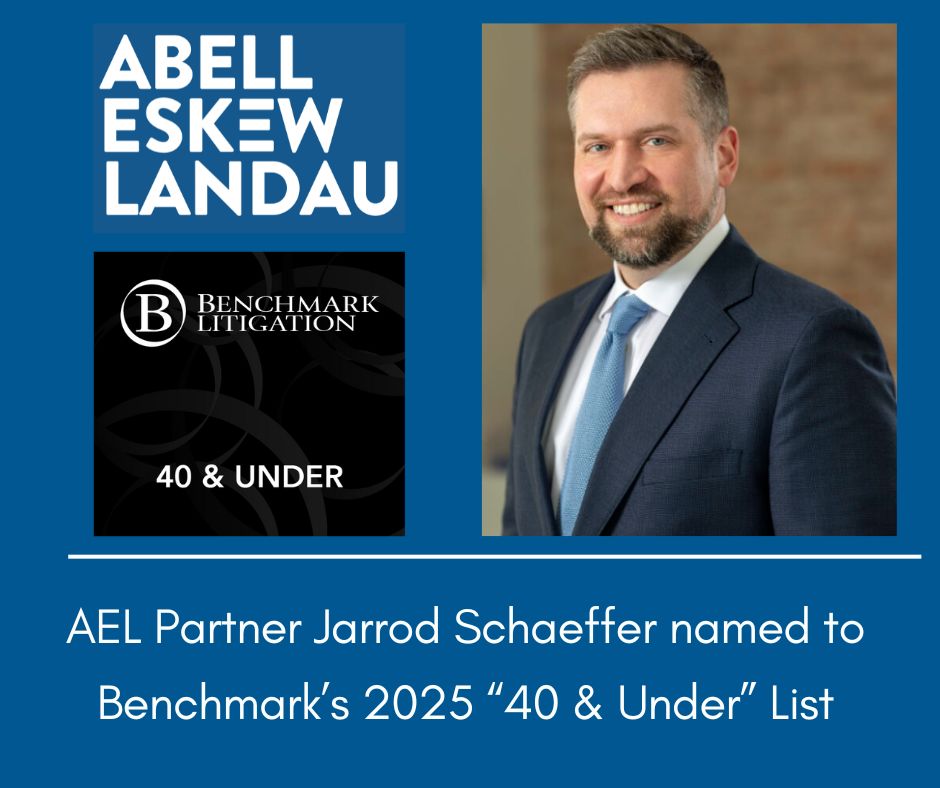
Jarrod Schaeffer Named to Benchmark Litigation’s 40 and Under List for 2025

.AEL is proud to share that partner Jarrod Schaeffer was named to Benchmark Litigation’s 40 and Under list for 2025. Each year, Benchmark Litigation works to identify the best and brightest litigators across the country, and the 40 and Under list seeks to recognize the top emerging talent in litigation. This is the second year in a row that Jarrod has been selected to this prestigious list.

Jarrod joined AEL as a partner in 2024 following more than five years in the U.S. Attorney’s Office for the Southern District of New York, where he was a senior member of the Public Corruption Unit. An experienced trial and appellate litigator, his practice focuses on white collar criminal defense, government investigations and enforcement, internal investigations, and complex commercial litigation. Since joining AEL, Jarrod has handled a number of high-profile matters, published articles on emerging issues in campaign finance and artificial intelligence, and maintained an active pro bono practice on behalf of a number of organizations.

Categories
news

Defendant that Defrauded Synagogue Represented by AEL Sentenced to 21 Months’ Imprisonment

AEL is proud to have represented Congregation Beth Israel (CBI), a conservative Jewish synagogue located in Scotch Plains, New Jersey. In early 2023, CBI learned that one of their long-time employees had been embezzling funds from the congregation’s bank accounts for at least three years and concealing her conduct by, among other things, falsifying bank documents and financial statements. The defendant further concealed her conduct by replenishing CBI’s bank accounts with unauthorized high interest merchant cash advance transactions taken in CBI’s name, causing further damage to the congregation’s financial circumstances. CBI is a non-profit, tightly-knit, member-led community that serves a diverse congregation that draws from several towns in and around Union County, New Jersey. Needless to say, the congregation was devastated to learn of the theft, which totaled approximately $400,000.

CBI’s Board acted swiftly in response to the theft and engaged AEL to conduct a thorough internal investigation, identify the perpetrator, and act as a liaison with federal law enforcement. Over the course of the next year, AEL collected and reviewed evidence of the fraud, including a forensic financial analysis of defendant’s activities, presented to the Board, and coordinated extensive cooperation with the FBI and U.S. Attorney’s Office.

On July 23, 2024, the U.S. Attorney’s Office for the District of New Jersey charged the defendant with wire fraud in violation of 18 U.S.C § 1343. The defendant pled guilty on March 18, 2025, accepting full responsibility for the offense conduct. AEL then represented CBI in connection with defendant’s sentencing, submitting evidence of the losses attributable to defendant’s conduct and coordinating CBI’s Victim Impact Statement. On July 22, 2025, the Court sentenced defendant to 21 months’ imprisonment, 2 years of supervised release, financial restrictions, including a prohibition from working as a bookkeeper or accountant in the future, and ordered that defendant make full restitution to CBI.

The sentencing concluded a difficult period for CBI as the victim of the offense. In a statement, CBI said, “our trust was deeply betrayed by someone who we viewed as a friend and colleague, and while we have been working toward healing over the past two years, we can now complete this process as we look toward the future as a strong and thriving community.”

As for AEL, CBI stated:

We would like to express our deepest gratitude to our attorney, David Eskew, who provided pro bono legal services to assist us with our internal review and served as our liaison to the Department of Justice. People like David remind us that for every betrayal, no matter how big or small, there are good people who are willing to give their time and energy to help us persevere through challenging times.

The case was handled by AEL partner David Eskew, of counsel Heather Suchorsky, and associate Raquel Frier.

AEL is a boutique law firm that specializes in white collar criminal defense, government investigations and enforcement matters, and internal investigations. AEL’s partners are all former federal prosecutors with extensive experience investigating and defending federal offenses. AEL has been repeatedly engaged to represent companies, corporate boards, and individuals in high-stakes matters involving federal and state law enforcement agencies, including engagements on behalf of high-profile victims.

The foregoing may constitute attorney advertising. Prior results do not guarantee future outcomes.

Categories
news

AEL Wins Complete Dismissal in False Claims Act (FCA) / Qui Tam Case

AEL is pleased to announce that, with our superb co-counsel from Kostelanetz LLP, we secured a complete dismissal, with prejudice, of all counts in a False Claims Act (FCA) lawsuit on behalf of our client, Jack Basch, the former Chief Executive Officer (CEO) of Shiel Medical Laboratory (which was also a defendant in the case). The case was handled by Scott Landau and Scott Glicksman.

The lawsuit, which was filed by a whistleblower under the qui tam provisions of the FCA in the U.S. District Court for the Eastern District of New York (EDNY), alleged that the defendants knowingly submitted false claims to Medicare and the New York and New Jersey Medicaid programs for lab tests that were not reasonable and necessary, and that were furnished pursuant to prohibited referrals in violation of the Stark Law and the Anti-Kickback Statute (AKS).

In dismissing all claims with prejudice, Judge Nicholas Garaufis of the EDNY held that the relator’s Fourth Amended Complaint – his fifth operative pleading in the case – failed to allege cognizable claims and suffered from numerous fatal defects, several of which alone  “constitute[d] an independent basis” for dismissal of the FCA claims and their state analogs. With respect to Mr. Basch specifically, the Court completely vindicated our client, holding that relator “fail[ed] to allege the submission of a single false claim to the government”; failed to plead facts supporting his requisite knowledge of any false claims; failed to allege any underlying violations of the AKS, or any willfulness under the AKS; failed to alleged any fraudulent physician self-referral scheme in violation of the Stark Law; and failed to properly allege a reverse false claim because it improperly “mirror[ed] the traditional false claims allegations.” And given that relator had amended his complaint four times previously, the Court denied his request for (further) leave to amend, and dismissed all claims against Mr. Basch and the rest of the defendants, with prejudice. 

We would like to thank Mr. Basch for entrusting this important case to us. We would also like to thank our co-counsel Claude Millman, Caroline Rule, and Michael Sardar from Kostelenatz LLP, and counsel to the other defendants, for their exceptional collaboration and teamwork in reaching this incredible result. 

AEL is a boutique law firm that specializes in FCA litigation and complex parallel criminal and civil white collar investigations and cases. We have extensive experience handling litigation on behalf of healthcare companies and a proven record of success in cases arising under the FCA, the Stark Law, the AKS, and federal criminal statutes, including matters arising from whistleblower and qui tam complaints. We are proud to have helped obtained this victory for our client and look forward to assisting other clients in future cases.

**The foregoing may constitute attorney advertising and readers are cautioned that prior results do not guarantee future outcomes.

Categories
news

AEL Partner Jarrod Schaeffer Named to 2025 Lawdragon “Next Generation” List

AEL is proud to share that Jarrod Schaeffer has again been recognized as a rising star in the legal professional by Lawdragon, which named him to their “500 X – The Next Generation” list for 2025.  The list seeks to identify and recognize future leaders in the law, and each year it assembles an elite collection of talented attorneys from myriad practices all over the world.  This is the second year in a row in which Jarrod has been selected to this prestigious list.

Jarrod joined AEL as a partner in 2024 following more than five years in the U.S. Attorney’s Office for the Southern District of New York, where he was a senior member of the Office’s Public Corruption Unit. An experienced trial and appellate litigator, his practice focuses on white collar criminal defense, government investigations and enforcement, internal investigations, and complex commercial litigation. Since joining AEL, Jarrod has handled a number of high-profile matters, published articles on emerging issues in campaign finance and artificial intelligence, and maintained an active pro bono practice on behalf of a number of organizations.

Categories
news

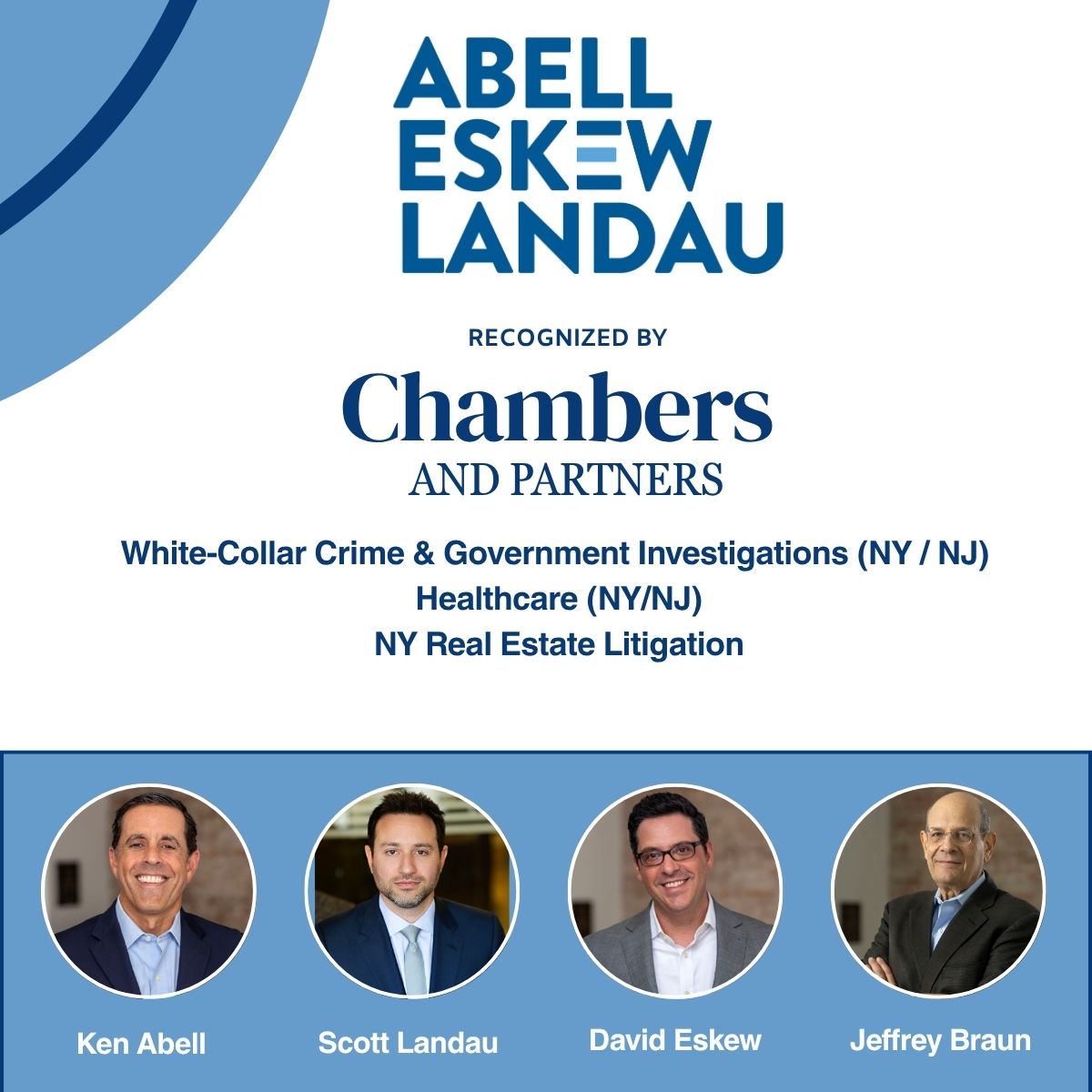
AEL Recognized by Chambers USA 2025 as Leading Law Firm for White Collar (NY and NJ), Healthcare (NY and NJ), and NY Real Estate Litigation

For the fifth consecutive year, AEL was recognized as a leading law firm in multiple categories. In the Chambers USA 2025 Guide, which was released earlier today, AEL was recognized in the areas of White-Collar Crime & Government Investigations in both New York and New Jersey; Healthcare in New York and New Jersey; and New York Real Estate Litigation. Chambers USA ranked AEL partners Ken Abell, David Eskew, and Scott Landau, and Counsel Jeff Braun, individually as well.

Each year, Chambers & Partners engages in a rigorous review process to generate its rankings, collecting scores of reviews and impressions from clients, referral sources and peers. In the Healthcare category, AEL stands alone as the only small boutique among giant national and international law firms. AEL is proudly ranked alongside some of the most recognizable law firms in the industry. As one client stated:

The AEL team “offers big-firm quality work in a boutique environment.”

AEL was also ranked among Specialist Firms in the White-Collar Crime & Government Investigations category in New York and New Jersey. AEL was ranked along with some of the best litigation boutiques in the country and was recognized for its exceptional knowledge, skill, pragmatism, communication and results. AEL’s team was described as “smart, efficient[,] creative[,] very responsive” and demonstrating “a superior knowledge of the law.” One client sated that AEL “offers quality work in a boutique environment” and “has a really talented group of lawyers.”           

Four of AEL’s attorneys were also recognized individually, as follows:

Ken Abell was ranked individually for New York White-Collar Crime & Government Investigations, New York Healthcare and New Jersey Healthcare. Ken was described as a “fantastic attorney” with an “excellent grasp of legal issues” and “an ability to speak to clients in a calming and reassuring way.”

David Eskew was ranked individually for New York Healthcare, as a New York Specialist in White-Collar Crime & Government Investigations, and for New Jersey White-Collar Crime & Government Investigations. One client stated that “David is a great lawyer. He is extremely accomplished and very attentive to the needs of his clients.” David was also described as a “zealous advocate for his clients” who “brings a wealth of experience handling criminal matters, whether at the corporate level or for individuals.”

Scott Landau was ranked individually for New York Healthcare. Scott has been described as a “brilliant attorney” who is “knowledgeable and responsive and has strong attention to detail.” 

Jeff Braun was recognized for his work in the area of New York Real Estate Litigation. Clients praised Jeff as a “terrific litigator” who “can handle a wide variety of cases with great skill.” As another client stated, Jeff “is fantastic to work with.” He “sees the big picture and knows what is at stake in complicated and difficult cases.”

Categories
news

AEL Files Amicus Brief in Supreme Court Case Relating to Sentencing Reductions

AEL and FAMM File Amicus Brief in Rutherford v. United States

On February 21, 2025, Abell Eskew Landau LLP and FAMM filed an amicus brief in the United States Supreme Court in Rutherford v. United States.  The brief urged the Supreme Court to grant a petition for certiorari filed by Daniel Rutherford, who had sought a sentence reduction in the lower courts pursuant to 18 U.S.C. § 3582(c)(1)(A) (sometimes called the “compassionate release” statute). The district court denied relief and the United States Court of Appeals for the Third Circuit affirmed, holding that a policy statement promulgated by the United States Sentencing Commission in 2023 permitting certain people to seek sentence reductions exceeded the broad authority that Congress expressly delegated to the Commission.     

The brief supports Petitioner’s argument that the Commission’s policy statement, U.S.S.G. § 1B1.13(b)(6), was valid, proper, and within the scope of the Commission’s authority.  Section 1B1.13(b)(6) provides that, when deciding whether a person has identified an extraordinary and compelling reason for a sentence reduction, courts may consider a later change in the law if the person has already served ten years of “an unusually long sentence” that, after full consideration of the person’s individualized circumstances, reflects “a gross disparity” between the sentence being served and the sentence likely to be imposed today. The Third Circuit’s decision reignites a division among the federal Courts of Appeals that § 1B1.13(b)(6) properly resolved, and it prevents many incarcerated people from even seeking to reduce lengthy sentences now acknowledged as unjust. The brief urges the Court to grant the petition in order to confirm the statutory authority of the Commission, the broad scope of courts’ sentencing discretion, and the relevance of changes in the law to motions seeking relief under § 3582(c)(1)(A).

The brief, which can be reviewed below, reflects the firm’s commitment to seeking justice in sentencing and advocating for the rights of incarcerated persons.

The AEL team includes Jarrod Schaeffer, Jeffrey Braun, Katherine Kulkarni, and Olivia Jecklin. The FAMM team includes Mary Price and Shanna Rifkin.

Categories
news

AEL Gets Probation for Pharmacist Client in Healthcare Fraud Case

AEL attorneys David M. Eskew and Heather Suchorsky obtained a probationary sentence (no jail time) in a federal healthcare fraud case on behalf of a pharmacist client. The case, which had been indicted in the Eastern District of New York, was part of a broader healthcare fraud scheme in which the conspirators allegedly paid kickbacks to obtain over $100 million in pharmacy billings. At the sentencing hearing, the government sought a “Guidelines” sentence of nearly three years’ imprisonment and contested the defendant’s submission regarding his role in the broader conspiracy. AEL won the disputed role enhancement issue and obtained a further downward variance based upon several factors under 18 U.S.C. § 3553(a).

The favorable sentence ended a lengthy ordeal for the client, which included a years’ long investigation and an indictment that had been pending for nearly two years more.

The client described AEL’s work in the case: “I am incredibly grateful for the dedication and skill that AEL brought to my case. Their strategic approach, deep understanding of the law, and unwavering support made all the difference in achieving this outcome. It was a long and difficult journey, but their guidance gave me confidence every step of the way.”

AEL specializes in federal white-collar criminal defense with a particular expertise in parallel criminal and civil investigations involving individual and institutional healthcare clients ranging from doctors, pharmacists, and other healthcare professionals to large national hospital systems, laboratories, life sciences companies, and healthcare adjacent entities. AEL has an established track record of assisting clients in avoiding and minimizing federal charges and pushing back against federal prosecutors and agencies with an evidence-based, detail-oriented approach.

*** The foregoing may constitute attorney advertising and readers are cautioned that prior results do not guarantee future outcomes.

Categories
news

AEL’s Banner 2024 in Review

2024 was yet another banner year for AEL with noteworthy results for our clients, growth in several of our practice areas, and a slew of recognitions and honors. We are proud to share just some of the highlights from a truly memorable year at AEL.

Growing Our Team

In 2024, we added to our deep bench of litigators. In January 2024, Jarrod Schaeffer joined AEL as a Partner, Jeff Braun joined as Counsel, and Olivia Jecklin joined as an Associate. Jarrod joined AEL after more than five years as an AUSA in the SDNY where he investigated and prosecuted cases involving corruption, fraud, and international money laundering. Jeff joined AEL following many years at a nationally renowned law firm. Jeff is a highly regarded litigator with broad experience handling commercial and business disputes. Olivia joined AEL from a top-ranked international law firm. AEL also welcomed two new paralegals, Veronica Banat and Charlotte Woods, both recent graduates with exceptional academic credentials. We are incredibly proud of our close-knit team and supportive culture and look forward to announcing more strategic additions to our team in the near future!

Noteworthy Cases and Results

In 2024, AEL continued its well-established track record of getting exceptional results in big cases. Here are just a few examples of our noteworthy results from 2024 and ongoing matters:

False Claims Act and Complex Civil Litigation

  • AEL obtained a civil-only settlement under the False Claims Act on behalf of a nursing home system that owned and operated more than a dozen skilled nursing facilities in the New York region and elsewhere. The highly favorable settlement resolved multiyear parallel criminal and civil investigations conducted by the U.S. Attorney’s Office for the Northern District of New York and the New York Attorney General’s Office. The case was handled by Ken Abell, Scott Glicksman, and Raquel Frier.
  • AEL resolved a pending qui tam action in the Southern District of New York on behalf of a New York-based cardiologist who was previously convicted of criminal charges in connection with a billing issue. The case was handled by Ken Abell, Jarrod Schaeffer, and Kate Kulkarni.
  • AEL procured the voluntary dismissal of all claims brought against multiple clients as part of a sprawling, multimillion dollar civil RICO action filed in New York federal Court. The case was handled by Scott Landau, Jarrod Schaeffer, and Jan Jorritsma.
  • AEL represents the Chief Executive Officer of a large laboratory company in an intervened qui tam action in the Southern District of New York. The client provided institutional and mobile COVID-19 testing services in New York and beyond during the height of the pandemic. The case is being handled by Scott Landau, David Eskew, Scott Glicksman, and Olivia Jecklin.
  • AEL represents the former Chief Executive Officer of a clinical laboratory in a declined qui tam action in the Eastern District of New York. The client’s laboratories provided services to medical practices and skilled nursing facilities. The case is being handled by Scott Landau and Scott Glicksman.
  • AEL represents a major hospital system in a declined qui tam action pending in the District of New Jersey. The client operated joint ventures regarding skilled nursing care that are alleged to have violated the federal Antikickback Statute. The case is being handled by Ken Abell, David Eskew, Jan Jorritsma, and Olivia Jecklin.
  • AEL represents a large health technology company in connection with a civil FCA investigation being conducted by the U.S. Attorney’s Office for the Eastern District of New York. The case is being handled by Ken Abell and Olivia Jecklin.

White Collar Criminal and Parallel Investigations

  • AEL is representing Linda Sun, a former public official in the New York State Government, in a significant prosecution in the Eastern District of New York involving alleged violations of the Foreign Agents Registration Act, visa fraud, alien smuggling, and money laundering. The case is being handled by Ken Abell, Jarrod Schaeffer, and Scott Glicksman.
  • AEL represents one of the country’s largest health systems in several ongoing criminal and civil investigations, including matters related to HIPAA, drug diversion, and False Claims Act investigations. Multiple investigations are pending in the Southern and Eastern Districts of New York, which are primarily being handled by Ken Abell, David Eskew, and Scott Landau.
  • AEL negotiated a favorable plea deal and obtained a sentence of probation for a pharmacist indicted in the Eastern District of New York. The probationary sentence constituted a substantial downward variance from a recommended Guidelines range of three years’ imprisonment. The case was handled by David Eskew and Heather Suchorsky.
  • AEL negotiated a favorable plea deal and obtained a sentence of time served for a Russian national in connection with a multimillion dollar computer fraud conspiracy prosecuted in the Eastern District of New York. The case was handled by David Eskew and Heather Suchorsky.  
  • AEL successfully navigated the former owner of multiple pharmacies through plea negotiations and sentencing in a case indicted in the Southern District of New York. AEL negotiated a favorable plea deal and handled the sentencing, at which the client received a meaningful downward variance. The case was handled by David Eskew and Scott Glicksman.
  • AEL obtained a sentence of 60 days’ imprisonment for a client convicted of leading a telecommunications fraud conspiracy. The case was prosecuted by the Southern District of California and then transferred to the Eastern District of New York for sentencing. The case was handled by David Eskew.
  • AEL obtained a substantial downward variance for a physician-client who pleaded guilty in the District of New Jersey to healthcare fraud charges arising from a genetic testing laboratory scheme. The case was handled by David Eskew and Heather Suchorsky.
  • AEL is serving as pool counsel on behalf of a large publicly-traded diagnostic laboratory services company in connection with a parallel investigation being conduct by the U.S. Attorney’s Office for the District of New Jersey. The case is being handled by David Eskew and Heather Suchorsky.
  • AEL is serving as pool counsel to a large national health system in connection with a parallel investigation being conducted by the U.S. Attorney’s Office for the District of New Jersey. The case is being handled by David Eskew.
  • AEL is representing a former employee of a durable medical equipment company who is being prosecuted in the District of New Jersey. The case is being handled by Ken Abell, David Eskew, and Scott Glicksman.
  • AEL represents a large publicly-traded company in connection with an investigation being conducted by the U.S. Attorney’s Office for the District of New Jersey. The case is being handled by David Eskew.

Healthcare Regulatory and Transactional Matters

  • AEL advised a prominent Article 28 diagnostic treatment center (DTC) in connection with a complicated transaction involving the restructuring of its facility lease and associated debts and obligations.    
  • AEL defended a large not-for-profit multispecialty provider in connection with a third-party payor audit and overpayment demand. The payor’s initial overpayment demand was approximately $3.4mm, however, AEL’ convinced the payor that is allegations were baseless. The payor agreed to drop the audit and demand in its entirety and to close the file. The client paid $0 in overpayments.  
  • AEL represented Ambulatory Surgery Centers in equity and asset sale transactions with private equity backed ventures and other provider entities. 
  • AEL advised multiple healthcare providers and “healthtech” ventures in connection with regulatory and compliance questions and issues, including questions regarding HIPAA privacy and security, Antikickback and Stark Law compliance, Medicare conditions of participation, FDA regulatory matters, and New York State healthcare issues.
  • AEL designed OMIG compliant compliance programs for practice groups and HIPAA compliance programs for healthcare providers and healthcare adjacent concerns.
  • AEL advised a medical practice in connection with a data breach incident and associated issues and questions regarding breach notification, mitigation, and exposure. 

Awards, Recognitions and Accolades

In 2024, AEL received deserved recognition for its excellent work. Below are some highlights:

  • In June 2024, AEL was once again ranked by Chambers USA as a leading law firm in Healthcare (NY), Specialist Litigation Firms in White Collar & Government Investigations (NY), and White Collar Crime & Government Investigations (NJ). Ken Abell, David Eskew, Scott Landau and Jeff Braun were all individually ranked in multiple categories.
  • In July 2024, Jarrod Schaeffer was selected to the 2024 Lawdragon 500 X “Next Generation” list.
  • In August 2024, Jarrod Schaeffer was named to Benchmark Litigation’s 40 and Under List.
  • Also in August 2024, Best Lawyers honored Ken Abell, Scott Landau, Scott Glicksman and Raquel Frier as Best Lawyers in Health Care Law. AEL was also ranked as a Best Law Firm in Health Care Law.
  • David Eskew and Jeff Braun were named to the Super Lawyers list. David Eskew was recognized as a Top Attorney in White Collar Criminal Defense. Jeff Braun obtained the honor for the 18th year in a row in the areas of Business Litigation, Land Use & Zoning and Environmental Litigation.
  • Scott Landau became an Adjunct Professor of Law at Brooklyn Law School, where he co-teaches a seminar on Healthcare Regulation. 

We are enormously grateful for our continued success and to our clients who continue to trust us with important and sensitive matters. We are proud to zealously represent their interests and we are looking forward to an even better 2025. Happy New Year to all.

Categories
blog

Recent Changes to Patient Consent and Payment Laws in New York: What Healthcare Providers Need to Know

New York State recently implemented significant changes to patient consent and payment laws that affect healthcare providers across the state. On October 20, 2024, new laws governing patient consent and payment procedures went into effect, prompting healthcare providers in New York to reassess their current practices. These changes, which are aimed at enhancing patient rights and financial transparency, introduce new requirements that impact how healthcare providers obtain patient consent, discuss costs for medical services, and process payments. As a result of these changes, healthcare providers face the challenge of adapting their policies and operations to ensure compliance. The following overview outlines key changes that providers need to be aware of to effectively comply with these new legal requirements.

Treatment and Payment Consents

The new Section 18-c of the Public Health Law requires that healthcare providers obtain patient consent for treatment, procedures, examinations, or other health care services separately from patient consent to pay for such services. This change forces providers to depart from the common practice of obtaining combined patient consent for treatment and payment. Further, Section 18-c stipulates that providers cannot seek patient consent for payment until two conditions are met: first, there must be a discussion about the costs of treatment, and second, the patient must have already received the healthcare services in question. To ensure compliance with this new law, providers may need to implement new patient consent protocols.

Ultimately, by mandating a cost discussion before payment consent, the law promotes price transparency and may help reduce instances of surprise billing. However, it also creates potential new challenges for healthcare providers, who must now deliver services before securing payment consent.

Restrictions on Pre-Authorization and “Cards on File

Section 519-a of the General Business Law introduces restrictions on healthcare providers’ billing practices. Specifically, it prohibits providers from mandating credit card preauthorization or requiring patients to keep a credit card “on file” as a prerequisite for receiving emergency or medically necessary services. As a result, this may lead to more conservative treatment approaches, as providers may be hesitant to perform procedures without upfront payment assurance.

New Patient Credit Card Notification Requirements

Section 519-a also requires that healthcare providers educate patients about the potential risks associated with using credit cards to pay for medical expenses. More specifically, providers must inform patients that they may lose certain state and federal protections related to medical debt when using credit cards. In anticipation of these legal changes, the New York State Department of Health issued guidance regarding the specific content of these patient notifications. Such guidance clarifies that patient notifications should include the following components: (i) medical bills paid by credit card are no longer considered medical debt; (ii) by paying with a credit card, patients are forgoing federal and state protections around medical debt; (iii) protections that patients must acknowledge forgoing include (a) prohibitions against wage garnishment and property liens, (b) prohibition against reporting medical debt to credit bureaus, and (c) limitations on interest rates; and (iv) patients must affirmatively acknowledge forgoing these protections by paying with a credit card.

Limitations on Provider Involvement in Medical Credit Applications & Prohibition on Assisting with Credit Card/Loan Applications

Pursuant to Section 349-g of the General Business Law, providers can no longer complete any portion of a patient’s application for medical credit cards and third-party medical installment loans or otherwise arrange for an application that is not completely filled out by the patient. This restriction may significantly impact how healthcare facilities assist patients in managing their medical expenses.

* * *

These new statutes likely require changes to previously existing workflows and documentation processes among health care providers in New York.  In order to ensure compliance with these legal changes, health care providers should audit their consent forms and payment processes, and stay informed about additional anticipated forthcoming guidance. AEL is continuing to monitor these legal changes.  If you have any questions, please reach out to us and we will be happy to assist.

Categories
news

Best Lawyers® Honors AEL and AEL Attorneys

Best Lawyers® honored AEL and three of its attorneys again this year.

AEL has been recognized again by “Best Lawyers” as a 2025 “Best Law Firm” in the area of Health Care Law. Additionally, four AEL attorneys took home individual honors. Partners Ken Abell and Scott Landau were named “Best Lawyers” in the category of Health Care Law. And associates Scott Glicksman and Raquel Frier were each named “Ones to Watch.”

The Best Lawyers in America list is one of the most reputable and recognized rankings of attorneys across the nation. Those honored on the list are divided by geographic region and practice area(s) and their work undergoes a significant peer review process.

Best Lawyers: Ones to Watch in America recognizes associates and other attorneys who are at earlier stages of their careers for their impressive performance and professional excellence in private practice. Although slightly newer than the traditional The Best Lawyers in America list, Ones to Watch utilizes the same robust peer-review process and methodology.

Categories
blog

NY Public Campaign Funding May Attract Scrutiny From Feds

This article was authored by Jarrod Schaeffer and was originally published in Law360’s Expert Analysis Section on June 4, 2024.

The upcoming elections across New York this year will be the first under the state’s new program, launched back in 2022, that provides public financing for state political campaigns.

Features of that program mirror New York City’s long-standing public financing program, including the provision of public funds to match small-dollar contributions.

Intended to increase average voters’ impact on state campaigns, the program also may open the door for greater scrutiny of state campaign finance violations by federal prosecutors.

Public Financing Programs in New York

Concerns over the influence of money in politics are nothing new, though the landscape has shifted markedly in recent decades. As election spending explodes, large contributions by select contributors may dwarf contributions by small donors. See, e.g., Sarah Fischer, U.S. Political Ad Market Projected to Reach Record $16 billion in 2024, Axios (Dec. 8, 2023), available here; Vanderwalker, et al., Analysis Shows Amplification of Small Donors Under New NY State Public Financing Program, Brennan Ctr. For Justice (Jan. 30, 2023), available here (“Last year, the 200 biggest donors to candidates gave almost $16 million, more than all 206,000 of the state’s small donors of $250 or less put together.”).

This shift stems in part from U.S. Supreme Court decisions cabining campaign finance regulation. See, e.g., How Does the Citizens United Decision Still Affect Us in 2024?, Campaign Legal Center (Jan. 15, 2024), available here (observing that political spending has “become a growing problem” following certain decisions “as each respective election cycle has seen record-breaking amounts of spending”). Rejecting concerns regarding large contributions in politics (See, e.g., New York Voters Support New Public Campaign Finance Program, Data for Progress (Feb. 28, 2023), available here (finding that “about 9 in 10 New York voters believe wealthy donors have more influence on politicians than the average voter wealthy donors have more influence on politicians than the average voter”—a belief that was “widely shared across partisanship, with 91 percent of Democrats, 93 percent of Independents, and 90 percent of Republicans saying the same.”)), the court declared in its 2010 Citizens United v. Federal Election Commission decision that “[i]ngratiation and access … are not corruption.” Citizens United v. Federal Election Commission, 558 U.S. 310, 360 (2010). And it has repeatedly curtailed regulation it believes could limit “gratitude” to large contributors or impede “the political access such support may afford,” as articulated in its 2014 decision in McCutcheon v. FEC. McCutcheon v. Fed. Election Comm’n, 572 U.S. 185, 192 (2014). It was not always this way. For many years, the Supreme Court acknowledged concerns that improper influence could result from large contributions. See, e.g., McConnell v. Fed. Election Comm’n, 540 U.S. 93, 143 (2003), overruled by Citizens United v. Fed. Election Comm’n, 558 U.S. 310 (2010) (acknowledging an “interest in combating the appearance or perception of corruption engendered by large campaign contributions”); Nixon v. Shrink Missouri Gov’t PAC, 528 U.S. 377, 389 (2000)) (observing that the Court has “recognized a concern not confined to bribery of public officials, but extending to the broader threat from politicians too compliant with the wishes of large contributors”); Austin v. Michigan Chamber of Com., 494 U.S. 652, 659 (1990), overruled by Citizens United v. Fed. Election Comm’n, 558 U.S. 310 (2010) (recognizing “that the compelling governmental interest in preventing corruption supports the restriction of the influence of political war chests funneled through the corporate form” (internal quotation omitted)); Fed. Election Comm’n v. Nat’l Conservative Pol. Action Comm., 470 U.S. 480, 497 (1985) (“Elected officials are influenced to act contrary to their obligations of office by the prospect of financial gain to themselves or infusions of money into their campaigns.”).

Public financing programs, like those in New York City and now New York state, are one way to address concerns about the effects of large contributions. While these programs survive, the Supreme Court has kept them on a tight leash. See, e.g., Arizona Free Enter. Club’s Freedom Club PAC v. Bennett, 564 U.S. 721, 754 (2011) (striking down a public financing program but stating that “governments ‘may engage in public financing of election campaigns’ and that doing so can further ‘significant governmental interests,’ such as the state interest in preventing corruption,” so long as such programs comport with the Court’s interpretation of the First Amendment); Davis v. Fed. Election Comm’n, 554 U.S. 724, 741 (2008) (holding that providing “level electoral opportunities for candidates of different personal wealth” is not “a legitimate government objective”).

While a state public financing program was a long time coming (for instance, last year a former co-chair of New York’s Moreland Commission to Investigate Public Corruption noted that the commission had recommended in 2013, among other things, that the state create a small-donor public financing system to help amplify the influence of average New Yorkers in the face of large contributions. Milton L. Williams, Don’t Give Up On Public Campaign Financing, City & State (Apr. 8, 2023), available here), New York City has long maintained a public financing program for municipal elections. See Friedlander, et al., The New York City Campaign Finance Act, 16 Hofstra L. Rev., Issue 2, art. 4 (1988) (noting passage of New York City’s Campaign Finance Act and

observing that “[i]n enacting this law, the city of New York has become the fourth, and largest, major local government to have instituted a mechanism for providing public funds to candidates seeking election to local office in return for the candidates’ agreement to abide by restrictions on contributions and expenditures”). A key feature of that program is the availability of public matching funds. Candidates who agree to abide by certain fundraising restrictions can receive public funds to supplement, in varying amounts, small-dollar contributions from New York City residents.

The goal of the program is to incentivize candidates to finance campaigns by engaging average voters over pursuing substantial sums from special interests. Matching Funds Program: How It Works, N.Y. Campaign Fin. Bd. (2024), available here.

The program is administered and policed by a nonpartisan independent agency called the New York City Campaign Finance Board, or CFB. About the CFB, N.Y. Campaign Fin. Bd. (2024), available here. In 2021, it distributed almost $127 million in matching funds to participating candidates. Honan, et al., Public Spending on 2021 NYC Elections Blew Away Previous Records, The City (Sept. 27, 2022), available here.

In 2020, the New York Legislature authorized the New York State Public Campaign Finance Program (Part ZZZ of Chapter 58 of the N.Y. Laws of 2020 (enacting N.Y. Elec. Law, art. 14, tit. 2), which, among other things, created a state-level funds matching program, and established a state Public Campaign Finance Board, or PCFB, to administer the program in a manner roughly comparable to that of the CFB. N.Y. Elec. Law, art. 14, tit. 2 § 14-207.

The state program went into effect as of Nov. 9, 2022 (Part ZZZ of Chapter 58 of the N.Y. Laws of 2020 (providing, inter alia, that the relevant sections “shall take effect on 11/9/2022 and shall apply to participants in the primary and general elections to be held in 2024”)), making the upcoming primary and general elections in 2024 the first to be conducted under the auspices of the state program.

As of early March, over 300 candidates had signed up for the state program (Press Release, N.Y.S. Pub. Campaign Fin. Bd. (Mar. 1, 2024), available here) which has allocated $100 million to distribute to eligible campaigns. See Alyssa Katz, State Campaigns Are About to Rake in $100 Million of Public Funding — While Also Spending All The Private Money They Want, The City (May 1, 2024), available here (“The new state budget provides $100 million for matching funds, nearly one-third of the total New York City has given candidates in the entire 36-year history of its system.”).

Federal Prosecutors and State Campaign Finance Violations

The state program’s implementation may provide new possibilities for federal prosecutors in New York. Elections are regulated through a complicated patchwork of federal, state and local laws. In some areas, such as election financing activities by foreign nationals, federal laws take precedence. 52 U.S. Code § 30121(a)(1) (providing, inter alia, that “[i]t shall be unlawful for . . . a foreign national, directly or indirectly, to make . . . a contribution or donation of money or other thing of value . . . in connection with a Federal, State, or local election”); see also United States v. Singh, 979 F.3d 697, 710 (9th Cir. 2020) (concluding that Congress has authority to regulate state elections as to foreign nationals pursuant to its broad power to regulate immigration and foreign affairs). In most other areas, however, states police their own elections under state law. See, e.g., Oregon v. Mitchell, 400 U.S. 112, 134–35 (1970) (Black, J.) (invalidating federal laws setting the voting age state and local elections to “save for the States the power to control state and local elections which the Constitution originally reserved to them and which no subsequent amendment has taken from them”).

Federal prosecutors are empowered to pursue offenses against the U.S. (28 U.S.C. § 547(1) (providing that “[e]xcept as otherwise provided by law, each United States attorney, within his district, shall . . . prosecute for all offenses against the United States”)), and are not authorized to enforce state or local statutes that undergird nonfederal campaign finance regulations.

There are, however, ways in which federal criminal charges can arise from violations of state or local campaign finance laws. Often, such charges turn not on state or local rules themselves, but on federal statutes targeting corruption and fraud. The most common examples are the federal crimes of bribery, 18 U.S.C. § 666, and mail or wire fraud, 18 U.S.C. §§ 1341, 1343. This article focuses on the fraud statutes and, unless otherwise indicated, refers collectively to the mail and wire fraud statutes “[b]ecause the mail fraud and the wire fraud statutes use the same relevant language” and courts generally “analyze them the same way.” United States v. Schwartz, 924 F.2d 410, 416 (2d Cir. 1991).

One of the most common ways prosecutors deploy those statutes is the investigation and prosecution of fake or straw donations that are used to obtain public matching funds. Such prosecutions frequently focus on efforts to obtain matching funds (although schemes to obtain matching funds are the focus of this article, they are not the only way in which federal prosecutors can bring charges predicated on violations of state or local laws. Depending on the facts of a particular case, other federal statutes may apply without any connection to public matching funds. See, e.g., 18 U.S.C. § 1952(a), (b) (prohibiting, inter alia, interstate travel with the intent to commit certain state law crimes, including “extortion” and “bribery”); 18 U.S.C. §§ 1956(c)(7)(A), 1961(1)(A) (prohibiting money laundering involving proceeds of specified unlawful activities including, among other things, inter alia, state law crimes of “extortion” and “bribery”); see also infra n. xxiv), because attempting to secure those funds makes public money the “object of [a] fraud,” to quote the Supreme Court’s 2020 decision in Kelly v. U.S. Kelly v. United States, 590 U.S. 391, 402 (2020) (quoting Pasquantino v. United States, 544 U.S. 349, 355 (2005)); see also United States v. Xing Wu Pan, 632 F. App’x 15, 16 (2d Cir. 2016) (upholding fraud convictions based on a straw donor scheme and noting that “the necessary result of the straw donor scheme was injury to the New York City Campaign Finance Board”).

In other words, federal prosecutors bring charges based on straw donor schemes that violate state or local campaign finance laws, not because those laws were broken, but because the scheme sought to “obtain[] money or property” in the form of matching funds “by means of false or fraudulent pretenses, representations, or promises” under Title 18 of the U.S. Code, Sections 1341 and 1343. 18 U.S.C. §§ 1341, 1343.

Conversely, prosecutors typically do not bring fraud charges where conduct merely provides false information — e.g., incorrect names, addresses or contribution amounts — to state or local regulators. See, e.g., Ciminelli v. United States, 598 U.S. 306, 309 (2023) (quoting United States v. Binday, 804 F.3d 558, 570 (2d Cir. 2015)) (holding that traditional property rights do not include allegations that a “scheme denies the victim the right to control its assets by depriving it of information necessary to make discretionary economic decisions”). Other federal statues prohibit altering information in ways that may be relevant to violations of state or local laws. See, e.g., 18 U.S.C. § 1519 (prohibiting the destruction, alteration, or falsification of records related to matters under federal investigation). Additionally, there may be circumstances where providing incorrect information causes inaccurate federal reporting, giving rise to other potential enforcement. See 52 U.S.C. §§ 30104 (imposing certain reporting requirements regarding contributions under the Federal Election Campaign Act), 30109 (providing for enforcement).

While accurate campaign finance information may be important, courts have held that the federal fraud statutes “protect[] only [an] … interest as property-holder, excluding protection of a governmental entity in its capacity as regulator,” as articulated by the

U.S. Court of Appeals for the Second Circuit in its 1989 decision in Corcoran v. American Plan Corp. Corcoran v. Am. Plan Corp., 886 F.2d 16, 20–23 (2d Cir. 1989); accord Cleveland v. United States, 531 U.S. 12, 20–21 (2000) (finding no property interest because “the State’s core concern [wa]s regulatory” where Louisiana law focused on “the importance of public confidence and trust” in licensed activities, ensuring such activities “are conducted honestly and are free from criminal and corruptive elements,” and “include[d] the distinctively sovereign authority to impose criminal penalties for violations of the licensing scheme” (emphasis in original)).

Since they primarily embody an interest in truthful disclosure, nonfederal campaign finance regulations likely serve a function “ancillary to … regulation, not to property,” in the words of the Second Circuit’s 1988 U.S. v. Evans decision. United States v. Evans, 844 F.2d 36, 42 (2d Cir. 1988) (concluding, in a case where defendants were charged with conspiring to provide false documents in order to obtain government approval for contemplated transactions, that the government’s right to control the future alienation of arms was not a property right for federal fraud purposes); see also Schwartz, 924 F.2d at 417 (citing Evans and concluding that “[w]hat was fraudulently obtained . . . was the government’s agreement to allow [] proposed transactions to take place,” which did not qualify as a property right because “[w]hether it chooses to use licenses or blanket rules, the government’s purpose is to control the private use of private property”); United States v. Murphy, 836 F.2d 248, 254 (6th Cir. 1988) (explaining that a state’s “right to accurate information with respect to its issuance of [] permits constitutes an intangible right” outside the scope of the federal fraud statutes).

Past federal prosecutions in New York have targeted fraudulent attempts to obtain matching funds administered by the CFB. For example, in U.S. v. Baldeo, the U.S. Attorney’s Office for the Southern District of New York charged a former New York City Council candidate in 2013 with fraud offenses based on a scheme to obtain matching funds during his 2010 municipal campaign. No. S1 13 Cr. 125 (PAC), 2013 WL 5477373 at *1 (S.D.N.Y. Oct. 2, 2013). Baldeo ultimately was acquitted of all fraud offenses at trial, but convicted of multiple obstruction of justice offenses.

The government alleged that Baldeo had straw donors complete contribution cards with their own identifying information, but provided, or had others provide, money orders or cash to fund the contributions. See id. Those cards allegedly were submitted to the CFB to obtain matching funds. Id.

Until the creation of the state program, there was no comparable federal hook regarding violations of state campaign finance regulations, because no state matching funds were available. That is no longer the case.

Providing public funds to eligible candidates through the state program may broaden federal prosecutors’ purview with respect to state campaign finance violations, since schemes that fraudulently attempt to obtain state matching funds likely seek to “obtain[] money or property” from the PCFB “by means of false or fraudulent pretenses, representations, or promises” in the same way that similar schemes sought to obtain matching funds from the CFB. 18 U.S.C. §§ 1341, 1343.

With millions of dollars in public money on the line (Rebecca C. Lewis, First $3.6 Million in New York Campaign Matching Funds Headed Out the Door, City & State (May 16, 2024), available here (noting that “[t]he fledgling New York Public Campaign Finance Board approved nearly $3.6 million in matching funds to 37 candidates last week in the first round of disbursements”)), federal prosecutors in New York may seek to leverage that possibility to combat perceived fraud or corruption.

Conclusion

As a result of New York’s provision of public funds to state campaigns, federal prosecutors may have new ways to bring charges predicated on violations of state campaign finance laws.

Only time will tell whether prosecutors seek to pursue these avenues, but responsible campaigns should consider taking steps early to avoid drawing undue federal scrutiny, including implementing a robust compliance program that looks for common indicia of straw contributions.

Jarrod L. Schaeffer is a partner at Abell Eskew Landau LLP. He previously served as an assistant U.S. attorney and as a senior member of the Public Corruption Unit in the U.S. Attorney’s Office for the Southern District of New York.

The opinions expressed are those of the author and do not necessarily reflect the views of their employer or its clients. This article is for general information purposes and is not intended to be and should not be taken as legal advice.

Categories
blog

Defense Attys Must Prep For Imminent AI Crime Enforcement

This Article – authored by Jarrod Schaeffer and Scott Glicksman – was originally published on April 4, 2024 in Law360’s Expert Analysis Section. The Law360 version is available here.

Ever since ChatGPT burst onto the scene in November 2022, new tools and applications using artificial intelligence and adjacent technologies have proliferated across multiple industries. See, e.g., Bernard Marr, A Short History of ChatGPT and How We Got to Where We Are Today (Forbes, May 19, 2023), available here.

And while governments and regulators have started implementing frameworks and guardrails for use cases of these technologies, federal criminal enforcement related to or involving AI is still relatively rare. But that may soon change.

Many have commented on how AI might facilitate new kinds of crimes, as well as the use of AI by the U.S. Department of Justice itself to uncover, track and prosecute criminal activity. Some of those efforts will require time and deliberation, such as the evaluation envisioned by the DOJ’s recently launched Justice AI initiative.

But white collar practitioners should also expect to see federal criminal enforcement issues involving AI arise in the near term, including even in pending cases.

DOJ Mobilization Regarding AI

As part of Executive Order No. 14110 on the safe and secure development of AI, issued on Oct. 30, 2023, President Joe Biden directed federal agencies, including the DOJ, to evaluate potential uses and pitfalls of AI. See, e.g., 88 Fed. Reg. 210 at 75191, 75211–75212, §§ 7.1(b)(i)(A)–(C), (F), available here.

General Lisa Monaco signaled that federal criminal law enforcement officials had begun working to implement the president’s directives. Deputy Attorney General Lisa O. Monaco, Remarks at the University of Oxford on the Promise and Peril of AI (Dep’t of Justice Feb. 14, 2024), available here.

Calling AI “a double-edged sword” with perhaps “the sharpest blade yet,” Monaco extolled the technology’s “potential to be an indispensable tool to help identify, disrupt, and deter criminals, terrorists, and hostile nation-states,” while recognizing “that AI can lower the barriers to entry for criminals.” She went on to say that AI was “changing how crimes are committed and who commits them — creating new opportunities for wanna-be hackers and supercharging the threat posed by the most sophisticated cybercriminals.” Id.

To combat those threats, Monaco announced the Justice AI initiative, which, “[o]ver the next six months, … will convene individuals from across civil society, academia, science, and industry to draw on varied perspectives” in order “to understand and prepare for how AI will affect the Department’s mission and how to ensure [it] accelerate[s] AI’s potential for good while guarding against its risks.” Id.

That initiative is expected to provide its findings by the end of this year, and may build on prior work by the DOJ’s existing Disruptive Technology Strike Force.

But Main Justice officials are not the only ones who will have a hand in policing AI misuses. (This article focuses solely on federal criminal law enforcement efforts and does not address civil enforcement efforts undertaken by a variety of by federal and state regulators.) The 94 U.S. attorney’s offices around the country also play important — and, in some cases, leading — roles in addressing new issues and trends in law enforcement. Prosecutors in those offices are unlikely to wait for the DOJ’s overall deliberative process to conclude — in fact, some have already charged cases that target crimes involving AI. See Press Release, Founder of Artificial Intelligence Start-Up Charged With Fraud (Dep’t of Justice, Aug. 15, 2023), available here; see also Press Release, Two Men Charged for Operating $25M Cryptocurrency Ponzi Scheme (Dep’t of Justice, Dec. 12, 2023), available here.

And Monaco’s remarks, combined with recent events, suggest that the DOJ is not asking them to wait.

Likely Areas of Interest for Federal Law Enforcement

Where should practitioners expect to see more immediate efforts targeting AI by federal prosecutors and law enforcement agencies? Considering Monaco’s recent remarks alongside prior clues from DOJ officials — and taking account of modern law enforcement practices and procedures — AI is likely to become an early focus in a few key areas.

First, prosecutors and agents will likely focus on how AI can facilitate the commission of familiar crimes, as well as how prosecutors can deploy existing tools to combat such misuses.

Since AI acts as a powerful force-multiplier for a wide range of activities, federal criminal enforcement tactics developed for traditional offenses may be readily adapted to cases where those offenses are made more serious or effective through AI.

This is where practitioners are most likely to first encounter these issues, whether in pending cases, ongoing compliance reviews or new investigations.

Second, prosecutors and agents will likely focus on areas where AI may enable new kinds of crimes that would not be possible otherwise, such as advanced AI-enabled cyberweapons and other sophisticated national security threats. See, e.g., Staying ahead of threat actors in the age of AI (Microsoft, Feb. 14, 2024), available here (describing how “[c]ybercrime groups, nation-state threat actors, and other adversaries are exploring and testing different AI technologies as they emerge, in an attempt to understand potential value to their operations and the security controls they may need to circumvent.”).

While industry professionals have yet to see examples of this conduct, most expect that it will soon confront law enforcement. See id. Combating these threats is likely to require the development of new law enforcement tools and the recruitment of additional personnel.

Third, prosecutors and agents will almost certainly explore how AI can be used to better uncover, track and prosecute all kinds of criminal activity.

As many attorneys are aware already from personal experience, AI can make aspects of their own practices more effective and efficient through advanced data processing, sophisticated pattern identification, and the automation of rote tasks. Those same benefits may be harnessed by prosecutors and federal agents, including through the use of AI-assisted document and evidence review tools, early versions of which have existed for years in various forms of less advanced technology-assisted review.

Traditional Offenses Utilizing AI

While prosecutors and agents are likely to eventually explore these and other areas, there are several reasons why their efforts may focus first on traditional offenses utilizing AI.

To begin with, focusing on how AI facilitates the commission of familiar offenses requires less expenditure of new resources, because prosecutors and agents can bring to bear the traditional investigatory tools and strategies that they use in other cases.

More drastic adaptations or paradigm shifts, on the other hand, may take longer, because AI is just as new for law enforcement as it is for society. That does not mean big changes will not come — just that they might take longer to have an impact.

More fundamentally, prosecutors are likely to be most comfortable addressing AI misuses through conventional legal frameworks. As Monaco has reiterated, “Fraud using AI is still fraud. Price fixing using AI is still price fixing. And manipulating markets using AI is still market manipulation.” Deputy Attorney General Lisa O. Monaco, Remarks at American Bar Association’s 39th National Institute on White Collar Crime (Dep’t of Justice Mar. 7, 2024), available here.

Prosecutors have a long history of repurposing existing statutes and enforcement tools to combat challenges arising from new technologies. For instance, in U.S. v. Chastain this past year, the U.S. Attorney’s Office for the Southern District of New York — which is often on the front lines of emerging issues — invoked the wire fraud statute, 18 U.S.C. § 1343, first enacted in the 1950s (66 Stat. 722, ch. 879, § 18(a) (July 16, 1952)), to prosecute fraud involving non-fungible tokens (See Press Release, Former Employee of NFT Marketplace Sentenced to Prison in First-Ever Digital Asset Insider Trading Scheme (Dep’t of Justice, Aug. 22, 2023), available here, which have a considerably more recent vintage. See, e.g., Sarah Cascone, Sotheby’s Is Selling the First NFT Ever Minted—and Bidding Starts at $100 (Artnet, May 7, 2021), available here (noting that the first-ever NFT was minted in 2014). More recently, in U.S. v. Austad, the Southern District of New York unsealed charges alleging, among other things, that the defendants “used artificial intelligence image generation tools” to advertise sales of stolen account credentials. U.S. v. Nathan Austad & Kamerin Stokes. See, e.g., Press Release, Two More Men Charged With Hacking Fantasy Sports and Betting Website (Dep’t of Justice, Jan. 29, 2024), available here.

Investigatory and Compliance Considerations

Given the range of traditional offenses where AI may be particularly easy to misuse, practitioners should expect the same ingenuity in investigations and prosecutions going forward.

For example, because AI can be used to quickly generate and distribute cutting-edge deepfakes and other professional-looking content, it might be used to induce fraud victims to purchase nonexistent goods or services through convincing advertising, enable or amplify a scheme to generate false identification materials, facilitate a market manipulation scheme through the dissemination of forged company literature (See, e.g., Brian Fung, U.S. Senators Propose Tough Fines for AI-driven Securities Fraud or Market Manipulation (CNN, Dec. 19, 2023), available here, or sow confusion intended to disrupt the electoral process through AI-generated robocalls. See, e.g., Holly Ramer, Political Consultant Behind Fake Biden Robocalls Says He Was Trying to Highlight a Need for AI Rules (Assoc. Press, Feb. 24, 2024), available here.

In fact, it appears that prosecutors may already have launched new inquiries focused on AI in the context of traditional crimes. In January, for instance, Bloomberg Law reported that “[p]rosecutors have started subpoenaing pharmaceuticals and digital health companies to learn more about generative technology’s role in facilitating anti-kickback and false claims violations.” Ben Penn, DOJ’s Healthcare Probes of AI Tools Rooted in Purdue Pharma Case (Bloomberg, Jan. 29, 2024), available here.

Such developments necessitate additional considerations not only by those responding to federal investigative inquiries, but also by compliance professionals.

As to the former, practitioners responding to subpoenas and other investigatory demands should carefully consider the capabilities of clients’ AI tools, their internal controls or other relevant compliance protocols, and potential misuses that may have prompted an inquiry or stimulate further interest from prosecutors.

Those same considerations are also important for compliance departments and those who develop or utilize AI for valid purposes, as Monaco has explicitly cautioned that prosecutors will assess management of AI-related risks when considering future resolutions of compliance and enforcement matters. Monaco, Remarks at American Bar Association’s 39th National Institute on White Collar Crime, (Dep’t of Justice Mar. 7, 2024), supra.

Implicit in that warning is the possibility that even AI created or utilized for proper purposes can be misused, and that the DOJ expects those who develop or use AI to take preventative measures.

In connection with appropriate investigations or compliance inquiries, practitioners should consider whether AI may have been utilized, regardless of whether the relevant conduct appears technologically sophisticated. Some uses of AI — such as text or code generation — may not be readily apparent, but nonetheless should be carefully evaluated. This is especially important as the public becomes increasingly conversant with widely available tools that have a variety of existing lawful uses, such as generative AI applications that create text and images.

Considerations for Plea Negotiations and Sentencing

The implications of this focus on AI misuses likely will also extend beyond the investigatory phase into plea negotiations and sentencing arguments, as prosecutors are likely to seek increased penalties that reflect any greater harm flowing from AI.

In February, Monaco observed that “[l]ike a firearm, AI can also enhance the danger of a crime,” and “[g]oing forward, where … prosecutors can seek stiffer sentences for offenses made significantly more dangerous by the misuse of AI — they will,” in addition to seeking reforms that provide additional penalties “if … existing sentencing enhancements don’t adequately address the harms caused by misuse of AI.” Monaco, Remarks at the University of Oxford on the Promise and Peril of AI, supra.

Monaco doubled down on this last month at the American Bar Association’s National Institute on White Collar Crime, emphasizing that “[w]here AI is deliberately misused to make a white-collar crime significantly more serious, our prosecutors will be seeking stiffer sentences — for individual and corporate defendants alike.” Monaco, Remarks at American Bar Association’s 39th National Institute on White Collar Crime, (Dep’t of Justice Mar. 7, 2024), supra.

This is a logical place for prosecutors to deploy tools and practices targeting AI misuse. Novel theories may be easier to advance in this context, because prosecutors have a lower burden of proof, evidentiary rules apply less stringently than they do at trial, and many provisions of the U.S. Sentencing Guidelines are intended to encompass a broad range of flexible policy considerations.

And to the extent that plea negotiations incorporate agreements over what enhancements apply, litigation risks for prosecutors regarding new twists on certain enhancements may be significantly reduced.

Practitioners should carefully consider these issues in the context of plea negotiations, while recognizing that prosecutors likely have significant leverage with respect to some traditional guidelines enhancements.

For example, a familiar enhancement for offenses that involved sophisticated means (U.S.S.G. § 2B1.1(b)(10)(C)) has been construed broadly to apply not only where an offense relied on specialized computer knowledge, (United States v. Hatala , 552 F. App’x 28, 30 (2d Cir. 2014) (upholding enhancement where defendant “used his extensive knowledge of computer programming and database systems, as well as self-written codes, to bypass professionally-designed security systems”) but also where an offense involved the use of readily available software. United States v. Calderon , 209 F. App’x 418, 419 (5th Cir. 2006) (rejecting, inter alia, argument that “printing checks using a computer program available for purchase by anyone at a local office supply store . . . did not constitute sophisticated means” because “[e]ven though certain aspects of [the] scheme were not sophisticated, the offense as a whole involved sophisticated means”). Prosecutors may seek to apply this enhancement in cases where an offense was facilitated by AI, even if the actual application used is generally commercially available.

Similarly, enhancements targeting the use of authentication features[25] have been applied to items ranging from forged notary seals (United States v. Sardariani, 754 F.3d 1118, 1122 (9th Cir. 2014)) to voice verification data (See, e.g., United States v. Barrogo, 59 F.4th 440, 446 (9th Cir. 2023) (concluding that an “authentication feature” encompasses “non-physical” means of identification like biometric data, including “voice or retina information”)—all things for which sophisticated AI might generate passable forgeries. See, e.g., Press Release, Gartner Predicts 30% of Enterprises Will Consider Identity Verification and Authentication Solutions Unreliable in Isolation Due to AI-Generated Deepfakes by 2026 (Gartner, Inc., Feb. 1, 2024), available here. Prosecutors may seek to apply these enhancements where AI was used to create deepfakes that circumvent advanced identity authentication measures. Practitioners should carefully consider the application of such guidelines provisions and attempt to anticipate how prosecutors may retool other conventional arguments based on the particular facts of a case. And it is important to consider such issues early in the life of a case, so that practitioners are prepared during plea negotiations that may significantly affect later positions taken at sentencing.

Conclusion

As technologies and applications utilizing AI continue to proliferate and new tools are developed, white collar practitioners should expect to encounter AI in federal criminal enforcement matters sooner rather than later. Even as the DOJ deliberates on an overall approach to AI, prosecutors and agents are likely to forge ahead while repurposing traditional strategies and tools. And because an early focus by those actors is likely to be where the misuse of AI facilitates the commission of conventional offenses, practitioners should carefully consider how clients — even those using or developing AI for lawful purposes, or in existing cases otherwise involving only traditional offenses — may use AI, and the significance it could have for an investigation or prosecution.

Categories
news

AEL Partner Jarrod Schaeffer Interviewed on NPR Regarding Jeffrey Epstein Case

AEL Partner and former federal prosecutor (SDNY) Jarrod Schaeffer was interviewed by NPR’s Leila Fadel regarding the release of additional documents connected to the Jeffrey Epstein case.

The interview, which was featured on WNYC’s Morning Edition, was aired on on January 5, 2024. You can listen and read the full transcript here, or listen to the full audio below.  

Categories
news

AEL Partner Jarrod Schaeffer Quoted in ABC News Article Regarding Upcoming Trump Trial

AEL Partner and former federal prosecutor (SDNY) Jarrod Schaeffer was quoted in a recent article by ABC News regarding the challenges facing both the prosecution and defense lawyers in jury selection in the upcoming Trump “hush money” trial.

The article, which was published on March 11, 2024, is entitled “Attorneys face unprecedented challenge in selecting jury for Trump’s hush money trial.” You can read the full article courtesy of ABC News here.

Categories
news Uncategorized

AEL Adds SDNY Prosecutor Jarrod L. Schaeffer and Prominent Litigator Jeffrey L. Braun to Growing Team

Abell Eskew Landau LLP (AEL), a boutique law firm specializing in white-collar criminal defense, government investigations, commercial litigation, and healthcare regulatory counseling, proudly announces that former Southern District of New York (SDNY) federal prosecutor Jarrod L. Schaeffer and highly regarded commercial litigator Jeffrey L. Braun have joined the firm.

Schaeffer joins AEL as a partner after serving for more than five years as an Assistant U.S. Attorney (AUSA) for the SDNY.  As an AUSA, Schaeffer investigated and prosecuted cases involving corruption, fraud, and international money laundering. Most recently, Schaeffer served as a senior member of the SDNY’s Public Corruption Unit where he handled some of the office’s most sophisticated and sensitive matters, including high-profile investigations and prosecutions of politicians, law enforcement officers, and attorneys. Schaeffer’s hire follows AEL’s addition of Heather Suchorsky, another former federal prosecutor, last year.   

“We are excited to welcome Jarrod to the firm as a partner and senior member of the team,” said David M. Eskew, one of AEL’s three founding partners and himself a former AUSA. “Jarrod is a phenomenal criminal and civil litigator, and with his addition, AEL’s ever-growing bench of talent now includes five former federal prosecutors from the U.S. Attorney’s Offices for the Southern and Eastern Districts of New York and the District of New Jersey, further building upon our already well-recognized capability to handle the most sophisticated and difficult white collar criminal cases in this region.”

“I’m very excited to join Ken, David, Scott, and the growing team at AEL,” said Schaeffer. “In just a few short years, the firm has developed an impressive track record and I look forward to assisting clients in criminal defense and government enforcement matters, as well as in complex commercial and civil litigation.”

Eskew explained the strategic value of the move. “Our white collar criminal defense and government investigations practices have grown substantially over the past few years following some notable successes, including dismissals of charged cases in the SDNY, EDNY and DNJ. As a result, we have been consistently engaged in charged cases and investigations in each of the three big federal districts in the NY/NJ metro area. By adding Jarrod to the team, we bring in a well-respected former prosecutor from SDNY, which was a piece we were previously missing. Now, half of our attorneys are former federal prosecutors and we can boast prior government service and experience in each of the major federal districts in our area. Our firm is already well-known for its expertise in criminal and civil healthcare fraud investigations. With the addition of Jarrod this year and Heather Suchorsky last year, we are poised to expand our reach and expertise in 2024 into other complex fraud cases, including public corruption, financial fraud and money laundering cases.”

Braun, who joins AEL as Counsel, is a highly regarded litigator and counselor with broad experience handling commercial and business disputes. Before joining AEL, Braun spent most of his career as a litigation partner at two national law firms. His practice focuses on complex and often high-profile commercial, real estate, land use, and environmental matters for leading developers, corporations, and nonprofit institutions. Chambers & Co. describes him as “a great litigator with deep experience,” and he was recently ranked number 13 on the New York City and State’s Law Power 100 List honoring lawyers with the biggest impact on New York State.

“Several years ago I had the privilege of working with Jeff on a high-profile land-use case. His skill and expertise handling complex matters led to a resounding victory for our client,” said AEL founding partner Scott R. Landau. “We are thrilled that Jeff is making the jump from ‘big law’ to our boutique law practice, where he will continue to serve clients in high-stakes commercial and real estate matters and will help further grow AEL’s civil litigation practice.”

“Joining a boutique law firm is an exciting change for me, and I’m thrilled to be here,” said Braun. “I was so impressed with Scott when we worked together a few years ago. Ken and David are equally impressive, and AEL has built such a strong team that I am grateful for the opportunity to be part of it.”

* * *

AEL was founded in 2020, just weeks before the global pandemic, by three former federal prosecutors. The firm specializes in white collar criminal defense and government investigations, with a particular focus on federal parallel criminal and civil investigations and cases in the healthcare industry in New York and New Jersey. The firm also handles complex commercial litigation and healthcare regulatory counseling. Since its launch, AEL has achieved consistent growth and has expanded to a team of ten attorneys, including five former federal prosecutors, and focuses on providing practical, no-nonsense, client-centered representation and counsel.